
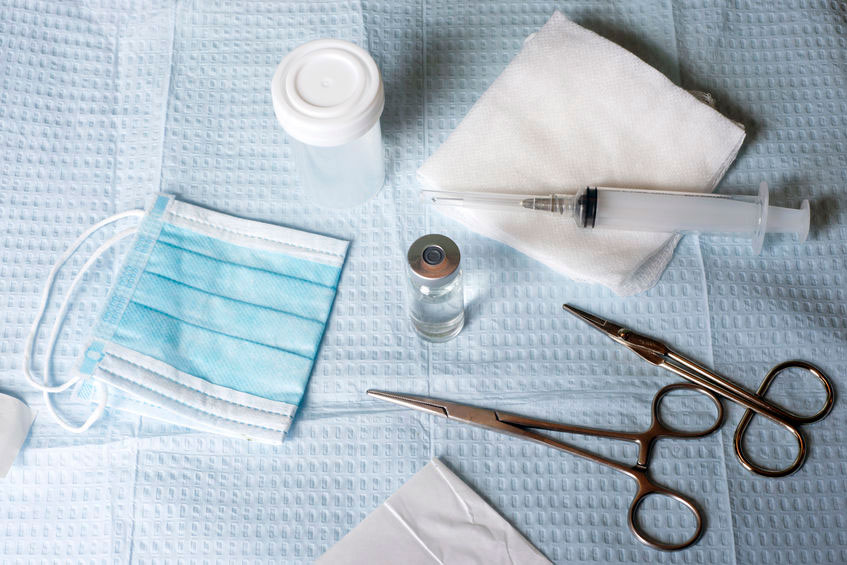
Private minor surgery for sebaceous cysts, epidermoid cysts, pilar cysts, and skin lesions

If you have a cyst that’s become sore, infected, or simply won’t stop catching on your clothing, we can help. At Essex Private Doctors in Brentwood, we provide specialist assessment and minor surgery for skin cysts and lesions — and before anything is removed, we examine it properly, using dermoscopy where needed, to make sure we’re treating the right thing in the right way.

Why patients choose us for cyst removal:

  • Specialist dermatology assessment with dermoscopy before any procedure
  • Same-day consultation and booking for surgery in most cases
  • Histology as standard — excised tissue sent for analysis to confirm diagnosis
  • Minor surgery performed by a GP with postgraduate dermatology training
  • Local anaesthetic procedure, no hospital admission required
  • Serving Brentwood, Chelmsford, Billericay, Colchester, and across Essex

Are You Struggling With A Cyst?

You’ve had this lump for a while. Maybe it’s on your back, your scalp, your face, or your neck. For a long time it was just there, quietly inconvenient. Then it got bigger. Or it became sore. Or it got infected and your GP gave you antibiotics, but it came back within weeks. Or it’s in a spot that catches on your collar every day, and you’ve simply had enough of it.

You know the NHS isn’t going to prioritise removing a benign cyst. Minor surgery waiting lists are long, and a cyst that’s cosmetically bothersome but clinically stable won’t be fast-tracked. You could wait a year or more.

What you actually need is someone to assess it properly, tell you what you’re dealing with, and remove it cleanly and competently — without a lengthy wait, without being passed between departments, and without being made to feel that something affecting your daily life isn’t worth treating.

What Kind of Cyst Do You Have?

There are many different types of skin cysts, and in the past we used to refer to all of them as ‘sebaceous’ cysts, although dermatologists tend to use the following terms:

Epidermoid Cysts

These develop in the top layer of the skin, and contain a cheesy, toothpaste-like material made of soggy keratin. Epidermoid cysts are slow-growing lumps that have a point in the middle, known as a punctum. They’re not painful (unless they become infected), and they commonly occur on the face, neck, chest and back.

They are benign (non-cancerous) in nature, and they form when the natural process of skin cell shedding doesn’t occur properly, and skin cells become trapped beneath the skin’s surface. Epidermal skin cells produce a protein called keratin, and the keratin build-up from the trapped cells eventually forms a cyst.

Dermoid Cysts

Sometimes a cyst will form in the deeper layer of skin known as the dermis, and these usually occur when a hair follicle becomes blocked. These cysts will often contain sebum (skin oil) and are also known as sebaceous cysts, or steatocystomas.

Pilar Cysts (Scalp Cysts)

Pilar cysts grow from hair follicles, and we mostly see these on the scalp (which is why they are also known as scalp cysts). They develop from the outer hair root sheath, and they fill up with keratin. They look like white or yellow dome-shaped lumps under the scalp skin. They are more common in women than men, and there’s a tendency for these to run in families – if you’ve had a parent who’s had a pilar cyst, you’ve a one in two chance of developing one yourself.
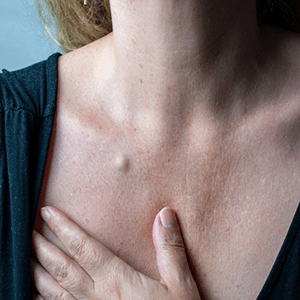
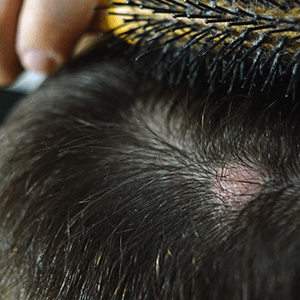
What About Lipomas, Moles, and Skin Tags?

We also see patients with other benign skin lesions that benefit from the same assessment and minor surgery approach — including lipomas (soft, fatty lumps beneath the skin), benign moles that are irritating, growing, or in an awkward location, and skin tags that catch on clothing or jewellery. If you’re not entirely sure what you have, that’s fine: part of the consultation is establishing exactly what we’re dealing with before any decision about treatment is made.

Book a Minor Surgery Consultation

Why Specialist Assessment Matters Before Cyst Removal

The majority of cysts are entirely benign, and we’ll tell you that plainly when that’s the case. But not every skin lump is what it appears to be at first glance. Part of what makes this service different from a standard GP minor surgery list is that we use dermoscopy — a specialist magnification technique that allows detailed examination of the skin and any underlying structures before a single incision is made.

Dermoscopy is standard practice in dermatology. It matters most for pigmented or unusual-looking lesions, where features invisible to the naked eye can indicate whether a lesion needs histological analysis or onward referral rather than straightforward excision. For a typical epidermoid or pilar cyst, it provides reassurance and confirms we’re treating what we think we’re treating.

Once a decision to remove has been made, we send excised tissue for histological analysis as standard in all but the most obviously benign cases. This means a laboratory examination of the removed tissue, providing an accurate confirmed diagnosis. It’s a step that cheaper or higher-volume clinics often skip. We don’t.

When Should a Cyst Be Removed?

There are many reasons you might want a cyst removed, and all of them are valid:

  • It has become repeatedly infected or inflamed
  • It is getting larger
  • It catches on clothing, jewellery, or when shaving
  • It is in a prominent or visible location and affects your confidence
  • It has become sore, tender, or painful
  • You want a confirmed diagnosis of what the lump actually is
  • Your NHS GP has declined to remove it, or the waiting time is too long

One important point: if your cyst is currently infected, it needs to settle before surgery. Operating through infected tissue risks incomplete removal and a higher chance of recurrence. We’ll assess this at your consultation and advise you clearly on timing.

Private cyst removal in Essex

Initial consultation

Your first appointment is a consultation, not a procedure. During this 20 to 30 minute assessment, we’ll examine your cyst carefully — using dermoscopy where appropriate — take a history of how long it’s been there, whether it’s been previously infected, and what you’ve already tried. We’ll confirm whether your cyst is suitable for in-clinic removal or whether it requires specialist referral — for example, if a cyst is very large, deeply situated, or shows any features warranting further investigation.

In most cases, we can confirm suitability at the consultation and arrange your procedure date at the same visit.

What happens during cyst removal surgery?

Draining a cyst won’t get rid of it in the long-run, because it will simply refill, but we can remove the entire cyst under a local anaesthetic procedure.

If you’re looking for cyst removal, Dr Henry Grundy-Wheeler is here to help. During your specialist skin surgery consultation, your problem will be carefully assessed and you’ll be given the opportunity to discuss all treatment options, including surgery.

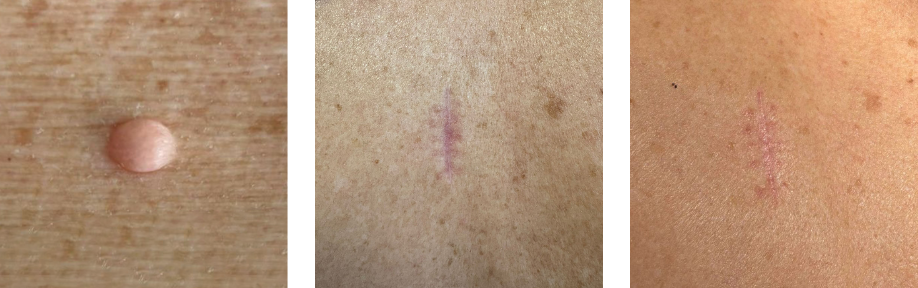
During the procedure, the skin is cleaned and local anaesthetic is gently injected under the skin and around the cyst. A small incision is made over the cyst, and the cyst is peeled out from under the skin. The incision is carefully stitched together, leaving a small scar. Care is taken to achieve the best-possible cosmetic appearance. The stitches may be absorbable or removed a few days later (usually around 10 days).

The whole procedure takes around 30 minutes, and you’ll leave with a dressing over the area. It’s important to keep this clean and dry, and you should avoid swimming, or activities that may cause rubbing of the surgical site. The wound will take a couple of weeks to completely heal, and you’ll be advised when to return for stitch removal.
 

The procedure

Cyst removal is performed under local anaesthetic and takes approximately 30 minutes. The skin is cleaned and local anaesthetic is injected around and beneath the cyst — most patients find this the only uncomfortable part, after which the procedure is painless. A small incision is made over the cyst, and the entire cyst — including its capsule — is carefully dissected free from the surrounding tissue. Removing the capsule intact is the key to preventing recurrence. The incision is then closed with sutures and covered with a clean dressing.

We take care with technique and closure to produce the smallest, neatest scar the site allows.

Immediately after your procedure

You can go home straight away. There is no recovery period, and most patients return to desk work the same day. You’ll need to keep the area clean and dry, avoid swimming and intense physical activity for around two weeks, and protect the wound from rubbing. Stitches are typically removed around 10 days after the procedure, or dissolvable sutures may be used depending on the location.

Healing and follow-up

The wound takes two to three weeks to fully heal. Excised tissue is sent for histological analysis, and we’ll share the results with you. Any concerns identified would prompt appropriate onward referral.

Understanding the Risks

Cyst removal is a low-risk procedure, but as with any minor surgery, there are small risks worth knowing about.

Scarring — any incision produces a scar. We aim to keep this as small and neat as possible, but the final size will depend in part on the size and location of the cyst. For cysts on the face or other visible areas, we discuss realistic expectations at the consultation stage.

Infection — a small risk with any skin procedure. Keeping the wound clean and dry reduces this significantly, and if infection does occur, it’s usually straightforward to treat with a short course of antibiotics.

Recurrence — if the cyst capsule is fully removed, recurrence is uncommon. Occasionally, if a cyst has been previously infected or ruptured, the capsule is more fragile and complete removal is more difficult. We’ll advise you at the consultation if this applies to your case.

Bleeding — minor bruising or slight oozing at the wound site is normal and settles quickly. Significant bleeding is rare.


Frequently Asked Questions

What is the difference between an epidermoid cyst and a sebaceous cyst? Technically, a true sebaceous cyst arises from a sebaceous (oil) gland and is relatively uncommon. Most of what people call “sebaceous cysts” are actually epidermoid cysts, arising from the upper skin layer rather than from oil glands. The treatment is the same, but the distinction matters for accurate diagnosis — which is why we send excised tissue for histological analysis as standard.

Will my cyst come back after removal? If the cyst capsule is removed in its entirety, recurrence is uncommon. Cysts that have previously been infected or burst may have a more fragile capsule, which can make complete removal more difficult. We’ll discuss this with you at your consultation.

Can I have a cyst removed while it’s infected? Not immediately. An active infection needs to settle first — usually with a short course of antibiotics — before surgery can safely proceed. Once the infection has cleared, removal can go ahead as normal.

Do you send cysts for testing? Yes. We send excised tissue for histological analysis as standard in all but the most obviously benign cases. This gives you a confirmed diagnosis and the reassurance of knowing exactly what has been removed.

Will I have a scar? Any incision leaves a scar. We aim to make this as small and neat as possible, and technique matters here. The final appearance depends on the size of the cyst and its location. We’ll give you a realistic expectation at your consultation.

Can you remove a cyst on my face? Yes, though facial cysts require particular care with technique and closure. We’ll discuss what’s achievable in terms of cosmetic outcome at the consultation.

Can you also remove moles, lipomas, and skin tags? Yes — these are all procedures we carry out as part of our minor surgery service. Moles that are changing, irritating, or in an awkward location can be assessed with dermoscopy before any decision on removal is made.

How quickly can I be seen? We offer appointments at our Brentwood clinic with minimal waiting times — typically within a week or two for a consultation, with the procedure booked shortly after. This compares favourably with NHS minor surgery waiting times, which can run to many months.

How much does cyst removal cost? A skin surgery consultation is required first, followed by a separate appointment for the procedure itself. Current fees are listed on our [fees page], and we’ll always give you a clear cost at your consultation. Histological examination occasionally incurs an additional charge, which we’ll advise you about in advance.

What if you think my lump needs specialist referral rather than in-clinic removal? We’ll always tell you honestly. If a cyst is very large, in an anatomically complex location, or if there are any features that warrant specialist input, we’ll refer you appropriately rather than proceed with a procedure that isn’t right for your situation.

Why Choose Essex Private Doctors for Cyst Removal?

Histology

Excised tissue is often sent for laboratory analysis. If there is any doubt about the lesion, you’ll know exactly what has been removed, and any unexpected findings are identified promptly.

Cosmetic care alongside clinical rigour

A neat result matters as much to patients as a clinically successful one. We take closure technique seriously and discuss realistic cosmetic expectations before any procedure goes ahead.

No unnecessary waiting

We provide rapid access — typically a consultation within a week or two, with a procedure date arranged shortly afterwards. If you’ve been waiting months on an NHS list while a cyst grows or repeatedly infects, we can move things forward significantly faster.

Essex-based, easily accessible

We’re based in Brentwood, with patients travelling to us from Chelmsford, Billericay, Colchester, Hornchurch, Romford, Shenfield, Ingatestone, and across Essex.

Book Your Cyst Removal Consultation

If you have a cyst that’s become a nuisance — whether infected, uncomfortable, growing, or simply something you want properly dealt with — book a consultation and we’ll assess it properly and advise you honestly on the right next step.

Essex Private Doctors provides specialist cyst removal and minor skin surgery in Brentwood, Essex, led by Dr Henry Grundy-Wheeler. Epidermoid cysts, pilar cysts, dermoid cysts, lipomas, moles, and skin lesions treated. Serving Brentwood, Chelmsford, Billericay, Colchester, Hornchurch, Romford, Shenfield, Ingatestone, and surrounding Essex areas.